



 Luke Benoit, the Minnesota PGA of America Section’s 2017 Teacher of the Year and 2024 Professional Development Award Winner, is the PGA Director of Instruction at Interlachen Country Club in Edina, Minnesota.
Luke Benoit on the importance of not always going slow in practice:
So many of us hear “don’t pound balls, go through your whole routine” when practicing, but one thing I’ve found in years of doing research and teaching people of all ages and skills is that sometimes going fast is actually helpful. Biomechanics are important for sure, but especially with the short game, sometimes doing one shot after another, one chip or putt after another, to different targets, is the best way to learn because more trials lead to more learning. We should be teaching golfers to learn to perform at different rates of practice, which almost no one does, but it’s a key tool in the motor learning toolbox for adding CI (contextual interference) to the task.
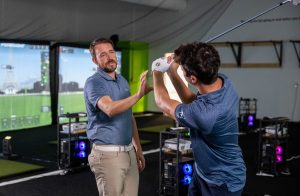


Luke Benoit on the business impact of not always going slow in practice:
When you really dive deep on motor learning you find out pretty quickly that how golfers practice leaves so much room for improvement. As a PGA of America Golf Professional I’ve found that individuals look to me for advice on how to practice so that the limited time they have at the course can be more efficient. Golfers so often struggle to understand when they should think about they swings and when they should just play. Integrating basic learning concepts in their practice plan has had a tremendous impact on my lesson book. Not only is my online business booming, but my in-person results are better. I’ve broken the swing work down into 3 distinct phases and a 7-step plan. We begin without a ball and learn the movement. Then we progress toward foam balls and integrate bias mitigation with path, face, and impact location. Lastly, we use real balls and begin adding difficult through higher CI (contextual interference). This can be done by changing the task slightly, changing the environment, by ramping up pressure and consequences, or by altering rate of practice (Click here to learn more). Understanding the full scope of levers to help golfers learn faster can supercharge your teaching practice.

If you would like to email the author of this Best Practice directly, please email luke@rypgolf.com.

